Do Liberal Arts Colleges Really Foster Good Practices in Undergraduate Education
GAEDE Institute | PROGRAMS The Conversation on the Liberal Arts

Liberal arts education is distinct from other approaches to higher education in many ways—its goals, its methods, even the context in which it is offered. Are there means in which the assessment of liberal arts education must vary accordingly? The seventh almanacConversation on the Liberal Arts : "Learning Beyond Measure?" addressed the assessment of liberal arts didactics. The briefing, sponsored past the Gaede Institute for the Liberal Arts, took identify at WestmontCollege , February 16-17, 2007. Representatives from liberal arts colleges and small private universities equally well as from accrediting agencies gathered to dialogue nigh approaches to assessment all-time suited to liberal arts education and nigh how accrediting agencies piece of work on cess with the liberal arts colleges and small private universities in their regions. Our hope is that out of this volition come greater familiarity on the office of liberal arts colleges of effective assessment methods and greater awareness on the part of accreditation agencies to the ways in which cess might look dissimilar at liberal arts colleges than information technology does at larger institutions.
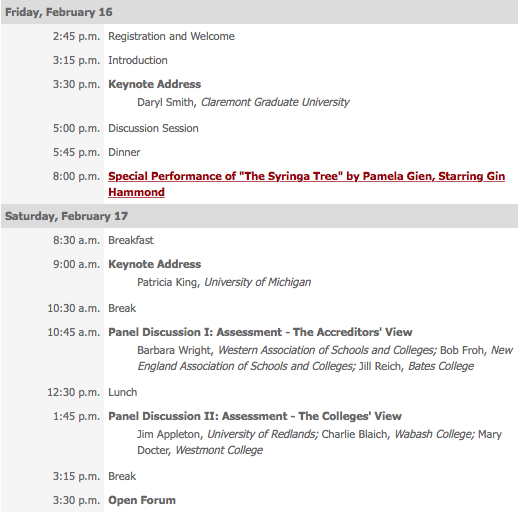
The program opened on Friday afternoon with a keynote accost from Daryl Smith Professor of Education and Psychology at Claremont Graduate University. Dr. Smith is an adept on diverseness in higher education and her work on assessment has focused on assessing diversity initiatives. The second keynote address was from Patricia Male monarch, Director for the Report of Higher and Postsecondary Didactics at the University of Michigan, who is currently taking part in the Wabash National Study of Liberal Arts Education.
In addition, we featured two panels addressing assessment from the bespeak of view of accreditation agencies on the one mitt and of liberal arts colleges and small universities on the other. Those representing accreditation agencies discussed the place of liberal arts colleges in their region and how their work with these colleges on cess might differ from their piece of work with other kinds of institutions. Our panelists were be Barbara Wright, Associate Director of the Western Association of Schools and Colleges (WASC), Robert Froh, Associate Director of the Commission of the New England Association of Schools and Colleges (NEASC), and Jill Reich, Vice President for Academic Affairs and Dean of the Faculty at Bates Higher.
The second panel explored assessment from the point of view of the liberal arts college or pocket-size university. Jim Appleton, Chancellor of the University of Redlands spoke from the presidential perspective. Charlie Blaich, Manager of Inquiries at the Center of Inquiry in the Liberal Arts at Wabash College discussed assessing the distinctive outcomes of a liberal arts education. Mary Docter, Professor of Spanish at Westmont Higher, addressed kinesthesia perspectives on cess.
On Friday dark the 2007 Conversation on the Liberal Artsfeatured a special performance of "The Syringa Tree," written by Pamela Gien and starring Gin Hammond.

The Syringa Tree is a deeply personal story of an abiding beloved between two families - ane white, one blackness - and the two children that are born into their shared Southward African household in the early 1960s. Spanning four generations, the story is told first by half-dozen-year-old Elizabeth Grace as she tries to make sense of the chaos, magic, and darkness of Africa.
The Syringa Tree was written by Pamela Gien in the mid 1990s and has been performed around the world ever since, typically with 1 extra inhabiting all 24 characters.
Our actress, Gin Hammond, comes to us from Seattle, Washington. Ms. Hammond received her MFA from the American Reperatory Theatre Institute for Avant-garde Theatre Training at Harvard Academy / Moscow Art Theatre Schoolhouse. She has received a Helen Hayes Accolade equally Outstanding Atomic number 82 Extra for her functioning of "The Syringa Tree," along with rave reviews.
The San Francisco Chronicle called her performance "breathtakingly versatile, superb, svelte, emotionally generous, impressive" and The Washington Post added, "every moment with this gifted young actress feels special."

 | Daryl One thousand. Smith is Professor of Education and Psychology at the Claremont Graduate University in Claremont, California. Prior to assuming her current faculty position at CGU in 1987, Smith served as a college ambassador for 21 years in planning, institutional research, and student affairs. Dr. Smith'south current research, teaching, and publications take been in the areas of organizational implications of diverseness, cess and evaluation, planning, governance, pupil affairs, and the impact of women's colleges and other special purpose institutions. In addition to numerous articles and papers, she is an author or co-author ofInterrupting the Usual: Successful Strategies for Diversifying the Faculty Assessing Campus Diversity Initiatives, The Impending Loss of Talent: Challenging the Assumption of Testing and Merit, The Claiming of Multifariousness: Alienation or Involvement in the Academy, Achieving Faculty Diversity: Debunking The Myths, Diverseness Works; The Emerging Picture of How Students Do good. For the last half-dozen years, she has been the Co-Pi on a major evaluation project for the James Irvine Foundation working with selected private colleges in California to evaluate their progress on diversity initiatives which has produced a written report, three enquiry briefs, and a monograph. She has worked on issues of evaluation issues both nationally and internationally, with numerous foundations across the country, and has served on many accreditation teams. |
 | Patricia M. King is a Professor in the Center for the Study of Higher and Postsecondary Education at the Academy of Michigan . Her enquiry focuses on learning and development amid belatedly adolescents and adults, including college students. She is especially interested in approaches to student development that explore the intersections amid developmental domains, such as intellectual, identity and social evolution, and how these affect collegiate outcomes ranging from citizenship to intercultural maturity to graphic symbol evolution. In addition to having published over 50 manufactures, she coauthoredDeveloping Reflective Judgment and co-editedLearning Partnerships: Theories and Models of Practice to Educate for Self-Authorship.She is currently Principal Investigator of the Academy of Michigan team of the National Study of Liberal Arts Instruction sponsored past the Center ofInquiry in the Liberal Arts at Wabash Higher . She served as the founding editor ofNearly Campus: Enriching the Student Learning Experience. She has likewise served as Managing director of the Middle for the Study of Higher and Postsecondary Education at the University of Michigan, Assistant Vice President for Student Services at Ohio Country University, and Senior Inquiry Psychologist at the University of Iowa. |
 | James R. Appleton is Chancellor of the University of Redlands . Previously, he was President of the University of Redlands for 18 years. Prior to that, he served for 15 years at the Academy of Southern California as a member of the faculty, as vice president for educatee affairs, and and then as vice president for evolution. Earlier 1972 he served in various faculty and administrative positions at Oakland University in Rochester , Michigan . Dr. Appleton has taught graduate courses that focus on issues and trends in higher education. He recently completed a 3-year term equally Chair of the Western Association of Schools & Colleges Accrediting Commission for Senior Colleges and Universities. He served on a UNESCO working grouping from 2001-2003. He served for many years on the executive committee of the board of the Washington-based National Clan of Independent Colleges and Universities and the President'south Council of NCAA. He is on the Board of Directors of Redlands Centennial Banking company. Dr. Appleton received his undergraduate degree from Wheaton College and earned a master'southward degree and a Ph.D. from Michigan Country Academy. |
 | Charles Blaich currently serves equally the Director of Inquiries at the Center of Inquiry in the Liberal Arts at Wabash College. He received his Ph.D. in Psychology from the Academy of Connecticut in 1986. Afterwards a inquiry mail service-doc at the Academy of North Carolina at Greensboro, he served as an Assistant and then Associate Professor of Psychology at Eastern Illinois Academy from 1987-1991. Blaich joined Wabash College in the fall of 1991. While at Wabash College, Blaich received the Colleges McLain-McTurnan-Arnold Excellence in Teaching Award and two National Science Foundation grants. He previously received teaching awards from the University of Connecticut and Eastern Illinois University. In 2002, Blaich causeless his electric current position at the Centre of Inquiry. Blaich is also currently directing the Wabash National Study of Liberal Arts Education. Blaich'due south recent publications include "Do Liberal Arts Colleges Really Foster Good Practices in Undergraduate Education?" and "Liberal Arts Colleges and Liberal Arts Didactics: New Evidence on Impacts." |
 | Jill N. Reich has served as Vice President of Academic Affairs and Dean of the Faculty at Bates Higher since the summer of 2000. She received her B.A. from Regis Higher and her Ph.D. in Psychology from Dartmouth . She went on to build a distinguished career in developmental psychology at Loyola University of Chicago. Her research focused on the long term effects of prematurity, disease, and prolonged hospitalization and their affect on the development of perception, retentivity, and learning in infants and young children. At Bates, Dean Reich has successfully reorganized the kinesthesia workload, completed a comprehensive curriculum review leading to new General Instruction requirements, and launched a multiyear, consortial project that is currently working on identifying best practices for assessment and pupil learning. |
 | RobertC. Froh serves as Acquaintance Director for the Commission on Institutions of Higher Education at the New England Association of Schools and Colleges (NEASC). In this position, he supports the Committee and member institutions in framing expectations and support for assessment of educatee learning and institutional effectiveness; and supports institutions and the Committee in completing and reviewing institutional reports, self-studies, and peer evaluations. He has led several collaborative efforts among institutions designed to strengthen assessment of student learning and institutional effectiveness. These efforts have benefited from funding from the PEW Charitable Trusts, the Davis Educational Foundation, the MellonFoundation, and the Teagle Foundation. He was Manager of Cess at the Heart for Teaching Learning and Writing at Duke University from 1995-2000 and Associate Director of Evaluation at the Center for Instructional Evolution at Syracuse University from 1980-1995. He earned his Ph.D. in Measurement and Statistics at the University of Chicago where his mentors were Benjamin Bloom , Mihaly Csikszentmihalyi , and Benjamin Wright. |
 | Barbara Wright is Acquaintance Director of the Western Association of Schools and Colleges (WASC). She is a well-known and respected national expert on assessment and has all-encompassing feel in accreditation, serving six years equally a member of the New England Association of Schools and Colleges Commission on Institutions of Higher Education. She has experience in a diversity of higher didactics administrative positions, and is a frequent consultant on cess, general educational activity, foreign linguistic communication teaching, and faculty development. She is likewise co-author, with Andrea Leskes, ofThe Art and Science of Assessing General Education Outcomes. |
 | Mary Docter is Professor of Castilian at Westmont College. She holds bachelor's and master's degrees in Spanish and a Ph.D. in Hispanic Languages and Literatures, all from UCLA. She taught elementary school in United mexican states for two years as well as teaching at Scripps Higher (Claremont) and UCLA. She has been at Westmont since 1992, where she is currently a member of the WASC assessment squad. |
Source: https://www.westmont.edu/gaede-institute/programs/conversation-liberal-arts/2007
0 Response to "Do Liberal Arts Colleges Really Foster Good Practices in Undergraduate Education"
Post a Comment